Showing posts with label North Korea. Show all posts

4/12/2016

Stop Being Offensive


The United States on Saturday sternly admonished North Korea against acts that could "further destabilize" the region, amid claims that it successfully tested a new engine designed for an inter-continental ballistic missile that could reach US shores.

"We have seen the reports of North Korea's claims to have developed new engine technology for its ICBMs," read a statement from State Department Deputy Spokesman Mark Toner.

An intercontinental ballistic missile (ICBM) is a guided ballistic missile with a minimum range of 5,500 kilometres (3,400 mi) primarily designed for nuclear weapons delivery (delivering one or more thermonuclear warheads).

 Similarly, conventional, chemical and biological weapons can also be delivered with varying effectiveness, but have never been deployed on ICBMs. 

Most modern designs support multiple independently targetable reentry vehicles (MIRVs), allowing a single missile to carry several warheads, each of which can strike a different target.

Early ICBMs had limited precision (circular error probable) that allowed them to be used only against the largest targets such as cities. 

They were seen as a "safe" basing option, one that would keep the deterrent force close to home where it would be difficult to attack. 

Attacks against (especially hardened) military targets, if desired, still demanded the use of a more precise manned bomber. 

This is due to the inverse-square law, which predicts that the amount of energy dispersed from a single point release of energy (such as a thermonuclear blast) dissipates by the inverse of the square of distance from the single point of release. 

The result is that the power of a nuclear explosion to rupture hardened structures is greatly decreased by the distance from the impact point of the nuclear weapon. 

So a near-direct hit is generally necessary, as only diminishing returns are gained by increasing bomb yield.

"We call on North Korea to refrain from actions and rhetoric that further destabilize the region and focus instead on taking concrete steps toward fulfilling its commitments and international obligations," Toner said.

North Korea said its breakthrough would "guarantee" an eventual nuclear strike on the US mainland.

It was the latest in a series of claims by Pyongyang of significant new inroads in both its nuclear weapons and ballistic missile programs, although outside experts have treated a number of the claims with skepticism.

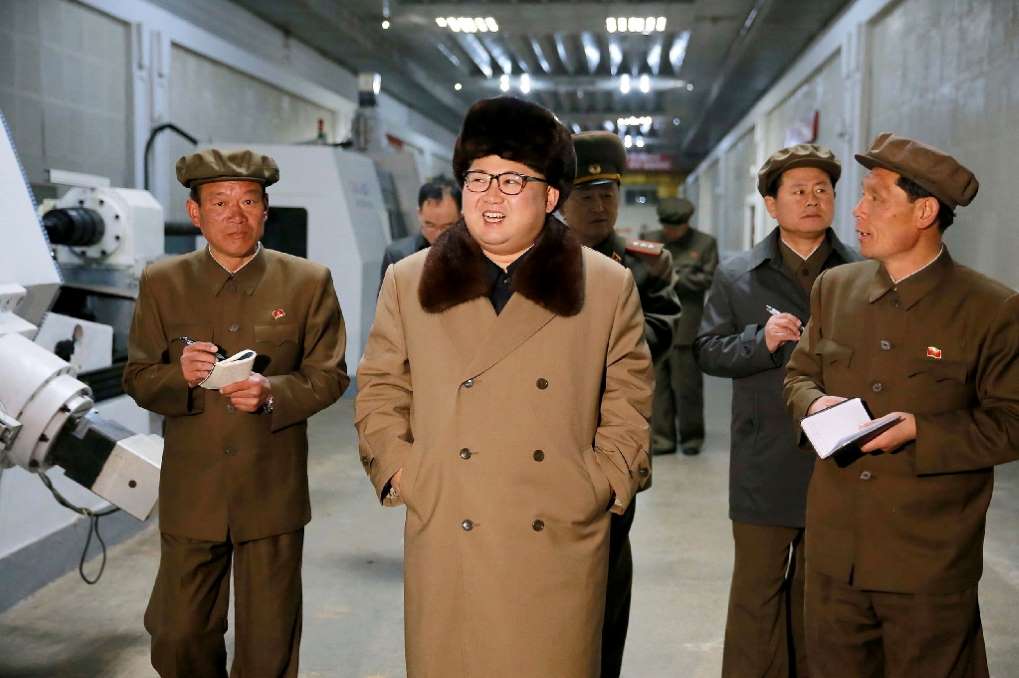
According to the North's official KCNA news agency, the ground engine test was ordered and personally monitored by the hermit nation's enigmatic leader Kim Jong-Un.

3/22/2016

US Student Jailed


US student Otto Warmbier (above) has been given 15 years hard labor in North Korea for crimes against the state.

Warmbier, 21, was arrested for trying to steal a propaganda sign from a hotel while visiting North Korea in January.

He later appeared on state TV apparently confessing and saying a church group had asked him to bring back a "trophy" from his trip.

North Korea sometimes uses the detention of foreigners as a means of exerting pressure on its adversaries.

The BBC's Stephen Evans in South Korea says the 15-year sentence is high compared to those given to foreigners in the past.

This could be due to the particularly high tensions at the moment between North Korea and the US, he says.

North Korean state news agency KCNA said Warmbier was convicted under an article of the criminal code relating to subversion. The verdict was handed down by the Supreme Court.

Warmbier, a student at the University of Virginia, was arrested on 2 January as he was trying to leave North Korea. He was accused of committing "hostile acts". 

KCNA said at the time he had gone to North Korea "to destroy the country's unity" and that he had been "manipulated" by the US government. 

At the end of February, at a tearful press conference in Pyongyang, he said he had "committed the crime of taking down a political slogan from the staff holding area of the Yanggakdo International Hotel". 

"The aim of my task was to harm the motivation and work ethic of the Korean people. This was a very foolish aim," he was quoted as saying. 

He said it was the "worst mistake" of his life.

North Korea detainees often recant their confessions once out of the country.

US tourism to North Korea is legal but the US State Department strongly advises against it.

The sentencing comes a day after veteran US diplomat Bill Richardson met North Korean officials at the UN in New York to try to push for Warmbier's release. 

Mr Richardson has previously been involved in negotiations to secure the release of Americans from North Korea detention.

Human Rights Watch (HRW) condemned the sentence: "North Korea's sentencing of Otto Warmbier to 15 years hard labour for a college-style prank is outrageous and shocking" said Phil Robertson, deputy director of HRW's Asia division, in a statement.

North Korean state media took a less lenient view: "The accused confessed to the serious offense he had committed against the DPRK, pursuant to the US government's hostile policy toward it, in a bid to impair the unity of its people, after entering as a tourist," reported the KCNA news agency.

The Democratic People's Republic of Korea (DPRK) is North Korea's formal name.

3/14/2016

North Korea Fires One


SEOUL, March 10 (Reuters) - North Korea fired two short-range ballistic missiles into the sea on Thursday, Seoul said, as South Korea and the United States conducted massive war games.

The North also announced it has scrapped all agreements with the South on commercial exchange projects and would "liquidate" South Korean assets left behind in its territory.

North Korea has a large stockpile of short-range missiles and is developing long-range and intercontinental missiles as well. 

The missiles fired on Thursday flew about 500 km (300 miles) off its east coast city of Wonsan and were likely from the Soviet-developed Scud series, South Korea's defense ministry said.

Japan, which is within range of the longer-range variant of Scud missiles or the upgraded Rodong missiles, lodged a protest through the North Korean embassy in Beijing, Japan's Kyodo news agency reported.

North Korea often fires short-range missiles when tensions rise on the Korean peninsula. 

Pyongyang gets particularly upset about the annual U.S.-South Korea drills, which its says are preparations for an invasion.

The U.S. and South Korea remain technically at war with the North because the 1950-53 Korean War ended in an armed truce instead of a peace agreement.

Around 17,000 U.S. military personnel are participating alongside some 300,000 South Korean troops in what South Korea's Defence Ministry has called the "largest-ever" joint military exercises.

North Korea on Sunday warned it would make a "pre-emptive and offensive nuclear strike" in response to the exercises.

After the short-range missile launches on Thursday, North Korea announced it would "liquidate" South Korean assets left behind in the Kaesong industrial zone and in the Mount Kumgang tourist zone.

Seoul suspended operations in the jointly-run zone last month as punishment for the North's rocket launch and nuclear test.

Mount Kumgang was the first major inter-Korean cooperation project. 

Thousands of South Koreans visited the resort between 1998 and 2008. Seoul ended the tours in 2008 after a North Korean soldier shot dead a South Korean tourist who wandered into a restricted zone.

North Korea is also livid about stepped up United Nations sanctions following its recent nuclear test and long-range missile launch.      Read More:

10/19/2015

We Want Treaty


Yesterday, North Korea rejected fresh talks over its nuclear program, dismissing overtures from the US and South Korea and calling instead for a peace treaty with its neighbor.

US President Barack Obama and his South Korean counterpart Park Geun-Hye on Friday said they were ready to engage with Pyongyang if the country agreed to give up its nuclear weapons. 

But the North's foreign ministry said any negotiations on its nuclear program were off the table until a truce signed at the end of the Korean conflict in 1953 is replaced by a full peace treaty.

"No issue in which the countries concerned including the US are interested can be settled unless a peace treaty is concluded before anything else," it said in a statement released on state media.

"If the US insists on its hostile policy, it will only see the DPRK's limitless bolstering of nuclear deterrence and the growth of its revolutionary armed forces," it added, using another name for North Korea.

North and South Korea remain technically at war under a truce signed to end the 1950-53 Korean War, and the two came to the brink of armed conflict this summer until a deal was sealed in August.

Tensions are still running high, however, and Pyongyang has threatened to conduct a fourth nuclear test as part of a weapons and missile program that it has pursued despite international sanctions. Read more

10/21/2014

NK Labor Camps


UNITED NATIONS (AP)€” North Korea publicly acknowledged the existence of its labor camps, an admission that appeared to come in response to a highly critical U.N. human rights report earlier this year.

Diplomats for the reclusive, impoverished country also told reporters that a top North Korea official has visited the headquarters of the European Union and expressed interest in dialogue, with discussions on human rights expected next year.

North Korea's deputy U.N. ambassador Ri Tong Il said the secretary of his country's ruling Workers' Party had visited the EU, and that "we are expecting end of this year to open political dialogue between the two sides." The human rights dialogue would follow.

In Brussels, an EU official confirmed a recent North Korea meeting with the EU's top human rights official, Stavros Lambrinidis, but said any dialogue currently planned is limited to rights issues.

Choe Myong Nam, a North Korean foreign ministry official in charge of U.N. affairs and human rights issues, said at a briefing with reporters that his country has no prison camps and, in practice, "no prison, things like that."

Click on image to enlarge

But he briefly discussed the "reform through labor" camps. "Both in law and practice, we do have reform through labor detention camps, detention centers ” where people are improved through their mentality and look on their wrongdoings," he said.

Such "re-education" labor camps are for common offenders and some political prisoners, but most political prisoners are held in a harsher system of political prison camps.

The North Korean officials took several questions but did not respond to one about the health of leader Kim Jong Un, who has made no public appearances since Sept. 3 and skipped a high-profile recent event he usually attends.


The officials said they don't oppose human rights dialogue as long as the issue isn't used as a "tool for interference." Their briefing seemed timed in advance of the latest resolution on North Korea and human rights that the EU and Japan put to the U.N. General Assembly every year.

8/05/2014

Secret Deal


Hamas militants are attempting to negotiate a new arms deal with North Korea for missiles and communications equipment that will allow them to maintain their offensive against Israel, according to Western security sources.

Security officials say the deal between Hamas and North Korea is worth hundreds of thousands of dollars and is being handled by a Lebanese-based trading company with close ties to the militant Palestinian organization based in east Beirut.

“Hamas is looking for ways to replenish its stocks of missiles because of the large numbers it has fired at Israel in recent weeks,” explained a security official. “North Korea is an obvious place to seek supplies because Pyongyang already has close ties with a number of militant Islamist groups in the Middle East.”

Using intermediaries based in Lebanon, Hamas officials are said to be intensifying their efforts to sign a new agreement with Pyongyang to provide hundreds of missiles and communications equipment that will improve the ability of Hamas fighters to coordinate operations against Israeli forces.

The relationship between Hamas and North Korea first became public in 2009 when 35 tons of arms, including surface-to-surface rockets and rocket-propelled grenades, were seized after a cargo plane carrying the equipment was forced to make an emergency landing at Bangkok airport.

Following Israel’s latest military offensive against Hamas operatives based in Gaza, Western security officials say Hamas is now trying to persuade North Korea to provide fresh supplies of rockets to replace the thousands of missiles that have been fired at Israel since the commencement of hostilities two weeks ago.

Israeli military commanders supervising operations against Gaza believe North Korean experts have given Hamas advice on building the extensive network of tunnels in Gaza that has enabled fighters to move weapons without detection by Israeli drones, which maintain a constant monitoring operation over Gaza.


The North Koreans have one of the world’s most sophisticated network of tunnels running beneath the demilitarized zone with South Korea, and Israeli commanders believe Hamas has used this expertise to improve their own tunnel network.

4/02/2014

Git Outda Heaaar


North Korea's ambassador told U.N. rights diplomats (as reported by Stephanie Nebehay of Reuters) to "mind your own business" before they voted on Friday to demand the country face international justice for crimes against humanity likened to Nazi-era atrocities.

U.N. investigators said last month security chiefs and possibly Supreme Leader Kim Jong-un himself should be tried for ordering systematic torture, starvation and killings, saying the crimes were "strikingly similar" to those committed during World War Two.

The United Nations Human Rights Council in Geneva adopted a resolution, brought by Japan and the European Union and backed by the United States and South Korea, calling for the U.N. Security Council to hold to account those responsible.

Some 30 states voted in favur, six were against, with 11 abstaining.

During the debate, North Korean ambassador So Se Pyong rejected the resolution, telling the talks: "Mind your own business", drawing laughter from delegates on the last day of a four-week session to examine violations worldwide.

"Cooperation can never be compatible with confrontation."

The resolution recommends "that the report of the COI (commission of inquiry) be submitted through the General Assembly to the Security Council for its consideration and appropriate action, including through consideration of referral of the human rights situation to the appropriate international criminal justice mechanism".

However, Western and Asian powers concede that for now their chances of holding North Korea liable for crimes against humanity and influencing the isolated country are slim.

China and Russia, which hold vetoes in the Security Council, were among those voting against the motion at the rights body.

The U.N. Human Rights Council also extended the mandate of its investigator on North Korea, Marzuki Darusman, by one year and agreed to establish a field office to help him collect more evidence and testimony.

The UN was created in 1945 principally to promote peace among nations. But its role in the 21st Century is unclear. Global terrorism, genocide and humanitarian crises have taken center stage. Critics charge internal corruption and attempts by member nations to use the UN to rein-in the United States, one of the world’s remaining superpower, with the other two being Russia and China.


Would a stronger UN make for a more peaceful world? Or should America be wary about losing its right to act in its own interest?

10/17/2013

Big Talker


North Korea refused to sign a non-aggression pact that John Kerry, the US Secretary of State, offered last week on condition of denuclearization.

In a thinly veiled threat to strike the United States, the North's National Defense Commission (NDC), chaired by leader Kim Jong-Un, said the US government must withdraw its policy of hostility against the North if it wants peace on both the Korean peninsula and the "US mainland".

"(The United States) must bear it in mind that reckless provocative acts would meet our retaliatory strikes and lead to an all-out war of justice for a final showdown with the United States," a spokesman of the NDC was quoted as saying in a statement carried by Pyongyang's Korean Central News Agency.

"We emphasize again that the United States must withdraw various measures aimed to isolate and strangulate us. Dependent upon this are... peace and security, not only on the Korean peninsula but the US mainland as well."

The comments come after a two-day joint naval drill between Japan, South Korea and the US, which included an American nuclear aircraft carrier, sparked a series of angry responses and threats from Pyongyang.

On Friday the North slammed a naval drill by US, South Korean and Japanese warships as a "serious military provocation" and vowed to "bury in the sea" the American carrier taking part in the exercise.

The latest bellicose statement from the NDC demanded that the US lift sanctions against the North, stop the "constant nuclear blackmails" and various war drills.


It rejected as "intolerable contempt" a US demand that it should show tangible commitment towards abandoning its nuclear programs if it wants substantive talks with the United States.

"The denuclearization of the Korean peninsula is an inalterable policy goal of the DPRK government," it said, but added that getting rid of such weapons should also include a total removal of US nuclear threats against the North.

The US and South Korea have long demanded that Pyongyang show tangible commitment to ending its nuclear weapons program before the six-party talks, which have been stalled for several years, can resume.

The North has said for years it wants denuclearization of the whole Korean peninsula and that it is developing a nuclear arsenal to protect itself from the US military, which occasionally sends nuclear-powered warships and aircraft capable of carrying atomic weapons.

In February the North carried out its third underground nuclear test in defiance of UN Security Council resolutions, sending tensions soaring and raising fears of possible conflict. It also launched a rocket in December that Washington said was a disguised ballistic missile test.


As well as the two Koreas, China and the US the six-party talks also involve Russia and Japan.