Showing posts with label nasa. Show all posts

9/02/2014

Global Warming Update

NASA scientists described a recent “global warming hiatus” that shows Earth’s surface temperatures warming at a slower rate than previous decades – but it is still warming.


Norman Loeb delivered a lecture entitled, “The Recent Pause in Global Warming: A Temporary Blip or Something More Permanent?” at the NASA Langley Research Center auditorium on Tuesday. The talk addressed challenges to scientists and increased skepticism among climate change skeptics due to the recent “hiatus” of global warming.

The federal space agency climate scientist explored research into a slow-down in surface warming over the last 15 years referred to as the “Global Warming Hiatus.” In recent years, the global mean surface temperature on Earth has increased at a rate that is about one-third of that from the past 60 years.

The global warming hiatus occurred despite record-breaking temperatures in the 2000s, retreating Arctic sea ice, rising sea levels and a record high global concentration of carbon dioxide in the atmosphere, according to a statement released by NASA.

“Opinions vary about the hiatus, as some view it as evidence that man-made global warming is a myth,” NASA said in a press release. “Others explain that it is simply due to climate variability that is temporarily masking a longer-term temperature trend.”

“The question is what’s driving it?” said Loeb, according to the Virginian-Pilot. But his answer reflected the complexity of climate science and did not rule out either scenario based upon the last 15 years of the “global warming hiatus.”

Loeb said that changes in solar radiation, water vapor and aerosol particles in the air have likely played a role, but a major factor may be an El Nino-like pattern of climate variability that has historically coincided with a slowing in global warming. Loeb noted that a rise in global temperatures slowed in the 1940s as the Pacific Decadal Oscillation climate pattern was active – a pattern that similarly lasted 20-30 years.

“For average climate records, 30 years is like one data point,” said Loeb, reiterating that while the Earth is warming more slowly, it is still warming. “It’s really forcing us to look at our models and observations and ask questions.”

In the global warming slowdown of the past 15 years, Loeb points out that the temperature is rising at nearly one-third the rate as before. The average temperature in the U.S. has risen about 1.5 degrees since the beginning of the 1900s.


Loeb holds a doctorate in in atmospheric sciences from McGill University in Montreal, Canada, and is an atmospheric scientist in the Science Directorate at NASA Langley. Loeb is also the principal investigator of a satellite project called Clouds and the Earth’s Radiant Energy System (CERES).

6/17/2014

NASA Comes to Star Trek


  • Nasa scientist in Houston worked with an artist to create the concept
  • The interstellar spacecraft builds on previous designs that theoretically allow distant travel by bending space-time
  • Called IXS Enterprise, it is similar to the Star Trek ship of the same name
  • Dr White said the spacecraft could reach Alpha Centauri in two weeks
  • Warp travel is the focus of Christopher Nolan's 2014 movie Interstellar 


A Nasa scientist claims a mission into space isn’t necessarily just something reserved for science fiction - and has revealed a Star Trek-style ship that could make interstellar travel a reality.

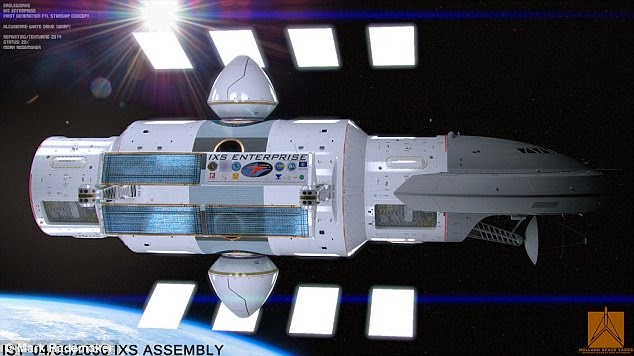
Pictured above is an illustration of Dr White's IXS Enterprise, an interstellar ship drawn by artist Mark Rademaker that could be an accurate representation of what the first mission beyond the solar system will look like. 

The IXS Enterprise is a theory-fitting concept for a faster than light (FTL) ship.

Dr Harold White is famous for suggesting that faster than light (FTL) travel is possible.

The 100-year Starship Project is a joint endeavor run by Darpa, Nasa, Icarus Interstellar and the Foundation for Enterprise Development.

Announced in January 2012, the project has an overall goal of achieving manned interstellar travel by 2112.

To do so it is evaluating a number of different technologies, including ‘warping’ space time to travel great distances in short time frames at faster-than-light speeds.

The project is also considering building ‘generation ships’ that move slowly but have a self-sustainable long-term population.


To date Nasa has contributed $100,000 (£60,000) to the project and Darpa $1 million (£600,000).

Using something known as an Alcubierre drive (above), named after a Mexican theoretical physicist of the same name, Dr White said it is possible to ‘bend’ space-time, and cover large distances almost instantly.

This, in essence, would allow a spaceship to travel almost anywhere in a tiny fraction of the time it would take a conventional spacecraft.

The ship in Nolan’s Interstellar movie, as well as those in Star Trek, employ a warp engine.

And, in a series of new renders, Dr White reveals how a real spacecraft dubbed the IXS Enterprise could do the same thing.

The images are based on the artist who created the original look for the famous USS Enterprise ship from Star Trek - Matthew Jeffries.

To make the latest renders Dr White employed the help of artist Mark Rademaker and graphic designer Mike Okuda.


The ship has a number of features that make interstellar travel possible. This includes the two rings surrounding the central spacecraft - these are known as an Alcubierre drive and are used to 'warp' space-time and travel many light years in a matter of days.

The engine for Dr White's ISX Enterprise is based on something known as the Alcubierre drive. As shown in the illustration above this stretches space-time in a wave that causes the fabric of space-time ahead to contract while expanding the space behind, theoretically allowing 'faster than light' travel.

Although the speed of light is seen as an absolute, Dr White was inspired by Miguel Alcubierre, who postulated a theory that allowed for faster than light travel but without contradicting Einstein.

Alcubierre's theory was published in 1994 and involved enormous amounts of energy being used to expand and contract space itself - thereby generating a 'warp bubble' in which a spacecraft would travel.

Allowing space and time to act as the propellant by pulling the craft through the bubble would be like stepping on an escalator.

Despite Dr Alcubierre stating his theory was simply conjecture, Dr White thinks he and his team are edging towards making the realm of warp speed attainable.


This illustration shows Dr White's design in its entirety. Struts around the spacecraft show how it would be directly attached to the rings. At the front is the 'bridge' where the crew would conduct operations on the spacecraft. Towards the back is the cargo area where so-called exotic matter for fuel would be stored.

According to Gizmodo, their engine could get to Alpha Centauri in two weeks as measured by clocks on Earth.

The process of going to warp is also one that is smooth, rather than using a massive amount of acceleration in a short amount of time.


'When you turn the field on, everybody doesn't go slamming against the bulkhead, which would be a very short and sad trip,' Dr White said.


However, Dr White admits his research is still small-scale and is light years away from any type of engine that could be constructed into a spaceship like the USS Enterprise.

6/04/2014

A Missed Crater Discovered

An eagle-eyed NASA spacecraft has spotted a fresh crater on Mars large enough to cover half of a football field, and it's no puny Martian pockmark. In fact, the crater is the largest new impact site ever seen on the Red Planet using orbiter photos.

NASA's powerful Mars Reconnaissance Orbiter captured the photo of the new Martian crater after it suddenly appeared in March 2012. Mission scientists say it is the biggest fresh impact crater scientists have confirmed on any planet by using before-and-after images.


The crater likely was carved by a car-size asteroid in an impact event similar to last year's meteor explosion over Chelyabinsk, Russia, which shattered windows, damaged hundreds of buildings and left more than 1,000 people injured, NASA officials said.

Mars' new scar was first spotted about two months ago by Bruce Cantor, a scientist with Malin Space Science Systems who puts together weekly Martian weather reports. 

Cantor noticed an unusual dark dot while he was looking for dust storms and other events using images taken by the Mars Color Imager, or MARCI, a weather-monitoring camera built by Malin Space Science Systems on board NASA's Mars Reconnaissance Orbiter.

"It wasn't what I was looking for," Cantor said in a statement. "I was doing my usual weather monitoring and something caught my eye. It looked usual, with rays emanating from a central spot."

By going through the archives of daily images of the site, Canton pinpointed the date the impact event occurred. The crater was absent March 27, 2012, and then appeared sometime before the photo opportunity, on March 28, 2012.

Subsequent images taken with the orbiter's Context Camera (CTX) and High Resolution Imaging Science Experiment (HiRISE) revealed that there are actually two main craters at the site. These holes are surrounded by more than a dozen smaller pockmarks, likely created by bits of the blasted asteroid or material ejected from the main craters.

Darkened slopes in the 5-mile (8 kilometers) area around the craters suggest shock waves from the cosmic collision even triggered Martian landslides, NASA officials said.

3/26/2014

NASA Sees Collapse

Can modern man see their own demise coming?  One would think that would not be a problem but other great civilizations did not anticipate the end.  Actually, too much inequality and too few natural resources could leave the West vulnerable to a Roman Empire-style fall.


If we're to avoid their fate, we'll need policies to reduce economic inequality and preserve natural resources, according to a NASA-funded study that looked at the collapses of previous societies.

"Two important features seem to appear across societies that have collapsed," reads the study. "The stretching of resources due to the strain placed on the ecological carrying capacity and the economic stratification of society into Elites and Masses."

In unequal societies, researchers said, "collapse is difficult to avoid.... Elites grow and consume too much, resulting in a famine among Commoners that eventually causes the collapse of society."

As limited resources plague the working class, the wealthy, insulated from the problem, "continue consuming unequally" and exacerbate the issue, the study said.

Meanwhile, resources continue to be used up, even by the technologies designed to preserve them. For instance, "an increase in vehicle fuel efficiency technology tends to enable increased per capita vehicle miles driven, heavier cars, and higher average speeds, which then negate the gains from the increased fuel-efficiency," the study said.

The researchers used what they termed a Human And Nature DYnamical (HANDY) formula to reach their conclusions. The formula uses factors such as birth rates, resources, and income classes to create a mathematical equation to project outcomes.

The study was sponsored by NASA's Goddard Space Flight Center and headed by the National Science Foundation's Safa Motesharrei.

For those who think modern society is immune from the problems that brought down ancient civilizations, a "brief overview of collapses demonstrates not only the ubiquity of the phenomenon, but also the extent to which advanced, complex and powerful societies are susceptible to collapse," the study said.


So how do we save ourselves? "Collapse can be avoided, and population can reach a steady state at the maximum carrying capacity, if the rate of depletion of nature is reduced to a sustainable level, and if resources are distributed equitably," reads the report.

8/26/2012

Back In Space Forever

Goodbye Neil...

Neil Armstrong - 1969

Neil Alden Armstrong (August 5, 1930 – August 25, 2012) was an American astronaut, test pilot, aerospace engineer, university professor and United States Naval Aviator. He was the first person to walk on the Moon. Before becoming an astronaut, Armstrong was a United States Navy officer and had served in the Korean War. After the war, he served as a test pilot at the National Advisory Committee for Aeronautics High-Speed Flight Station, now known as the Dryden Flight Research Center, where he logged over 900 flights. He graduated from Purdue University and the University of Southern California.

You will be missed!

7/24/2012

RIDE SALLY RIDE 1951 TO 2012

A Very Special Woman
Exceptional Astronaut
Inspiration to Young Women
She Stole Our Hearts!


Rest in Peace
Sally Ride