Showing posts with label 3D Printing. Show all posts

6/24/2016

First 3D Printed Office Opened

 
Above:  Sheikh Mohammed bin Rashid Al Maktoum, Vice-President and Prime Minister of the UAE and Ruler of Dubai, signs on the board during the official opening of the world's first functional 3D printed offices in Dubai May 23, 2016. REUTERS/Ahmed Jadallah


REUTERS – Dubai has opened what it said was the world's first functioning 3D-printed office building, part of a drive by the Gulf's main tourism and business hub to develop technology that cuts costs and saves time.

The printers - used industrially and also on a smaller scale to make digitally designed, three-dimensional objects from plastic - have not been used much for building. 

This one used a special mixture of cement, a Dubai government statement said, and reliability tests were done in Britain and China.

The one-storey prototype building, with floorspace of about 250 square meters (2,700 square feet), used a 20-foot (6-metre)by 120-foot by 40-foot printer, the government said.

"This is the first 3D-printed building in the world, and it's not just a building, it has fully functional offices and staff," the United Arab Emirates Minister of Cabinet Affairs, Mohamed Al Gergawi, said.
"We believe this is just the beginning. The world will change," he said.

The arc-shaped office, built in 17 days and costing about $140,000, will be the temporary headquarters of Dubai Future Foundation - the company behind the project - is in the center of the city, near the Dubai International Financial Center.

Gergawi said studies estimated the technique could cut building time by 50-70 percent and labor costs by 50-80 percent. Dubai's strategy was to have 25 percent of the buildings in the emirate printed by 2030, he said.


What is 3D printing?

3D printing or additive manufacturing is a process of making three dimensional solid objects from a digital file. 

The creation of a 3D printed object is achieved using additive processes. In an additive process an object is created by laying down successive layers of material until the entire object is created. 

Each of these layers can be seen as a thinly sliced horizontal cross-section of the eventual object.


How does 3D printing work?

It all starts with making a virtual design of the object you want to create. 

This virtual design is made in a CAD (Computer Aided Design) file using a 3D modeling program (for the creation of a totally new object) or with the use of a 3D scanner (to copy an existing object). A 3D scanner makes a 3D digital copy of an object.

3d scanners use different technologies to generate a 3d model such as time-of-flight, structured / modulated light, volumetric scanning and many more.

Recently, many IT companies like Microsoft and Google enabled their hardware to perform 3d scanning, a great example is Microsoft’s Kinect. 

This is a clear sign that future hand-held devices like smartphones will have integrated 3d scanners. Digitizing real objects into 3d models will become as easy as taking a picture. 

Prices of 3d scanners range from very expensive professional industrial devices to 30 USD DIY devices anyone can make at home.


7/25/2014

Printing Private Parts

Last month it took more than 20 firefighters to free a US student who had become trapped inside a giant sculpture of a vagina in Germany. But genital art elicited a very different response in Japan this week, when police arrested an artist for distributing data that enables recipients to make 3D prints of her vagina.


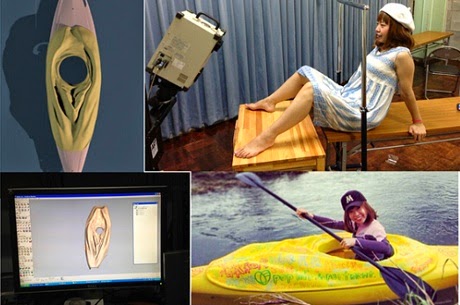
The artist, who works under the pseudonym Rokudenashiko – which roughly translates as “good-for-nothing girl” – was arrested after emailing the data to 30 people who had answered a crowd-funding request for her recent artistic venture: a kayak inspired on her own genitalia she calls “pussy boat”, according to Brian Ashcraft at the gaming website Kotaku.

The artist, whose real name is Megumi Igarashi, was held in custody in Tokyo on suspicion of breaking Japanese obscenity laws. Media reports said Igarashi, 42, denied the allegations. She pointed out that had not sent images of her vagina in return for money and did not recognise the scanned 3D data as obscene.

Kyodo quoted unnamed police sources as saying Igarashi had collected about 1m yen in exchange for the data.

While Igarashi's art has a fun-loving and cheeky theme, her situation is serious as far as the law is concerned: if convicted she could receive up to two years in jail or a fine of as much as 2.5 million yen (£14,300/US$24,500), according to her lawyer.

Commentators have pointed out the hypocrisy of her arrest, which comes soon after Japanese authorities resisted pressure to ban pornographic images of children in manga comics and animated films.

The activist Minori Kitahara said police raided Igarashi's office and seized 20 of her artworks. "Japan is still a society where those who try to express women's sexuality are suppressed, while men's sexuality is overly tolerated," she said.

Igarashi has made a name for herself with her
Decoman “Decorated Vagina” sculptures. The titles of the works incorporate the word “man”, from manko, the Japanese for vagina. Igarashi said she was once asked not to use the word Decoman during a TV appearance.

Because female genitalia were “overly hidden” in Japanese society, “I did not know what a pussy should look like,” she said in an online post. “I thought it was just funny to decorate my [moulded] pussy and make it a diorama, but I was very surprised to see how people get upset to see my works or even to hear me say manko.”


One of the works, described as a “vaginal battle scene”, shows a group of toy soldiers taking cover in an unmistakeably pubic crevice.

Another diorama titled Fukushiman – a “taboo on top of taboo” – shows workers at the wrecked Fukushima Daiichi nuclear power plant in similar surroundings.